I went to Agra with one photograph very much in mind: I wanted to capture the Taj Mahal in a way that showed not only its famous central dome, but also the symmetry, marble details, minarets, and scale that make the building so recognizable. After seeing the Taj Mahal in photographs for so many years, I wanted my own image to show the architecture clearly while giving it a sense of place.
Finding the composition I wanted was more difficult than I expected. The Taj Mahal attracts large crowds, and I needed an unobstructed view that did not look like the standard straight-on photograph. I moved away from the most common viewpoints and looked for an angle where the building would still dominate the frame. The surrounding trees created another challenge, but rather than exclude them, I began looking for a position where the branches could frame the monument without covering its important architectural features. The changing light also meant I had a limited amount of time to get everything aligned.
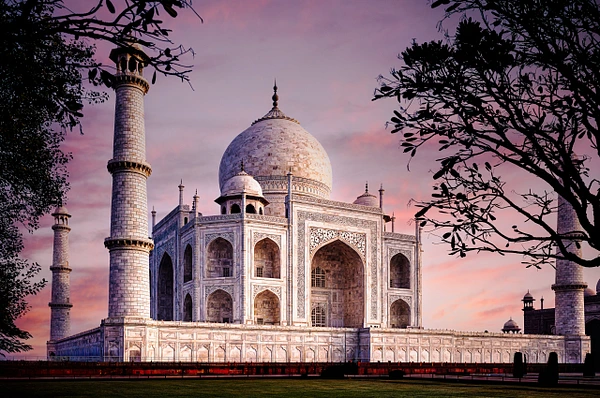
Eventually I found this viewpoint. The angled perspective revealed the central dome, facade, and minarets while the dark branches on either side formed a natural frame. At the same time, the sky developed shades of pink and purple that separated the white marble from the background and helped reveal the details of the structure. It was the combination I had been looking for—a photograph that clearly showed the Taj Mahal while presenting a view that felt different from the one I had seen so many times before.
I went to Agra with one photograph very much in mind: I wanted to capture the Taj Mahal in a way that showed not only its famous central dome, but also the symmetry, marble details, minarets, and scale that make the building so recognizable. After seeing the Taj Mahal in photographs for so many years, I wanted my own image to show the architecture clearly while giving it a sense of place.
Finding the composition I wanted was more difficult than I expected. The Taj Mahal attracts large crowds, and I needed an unobstructed view that did not look like the standard straight-on photograph. I moved away from the most common viewpoints and looked for an angle where the building would still dominate the frame. The surrounding trees created another challenge, but rather than exclude them, I began looking for a position where the branches could frame the monument without covering its important architectural features. The changing light also meant I had a limited amount of time to get everything aligned.
Eventually I found this viewpoint. The angled perspective revealed the central dome, facade, and minarets while the dark branches on either side formed a natural frame. At the same time, the sky developed shades of pink and purple that separated the white marble from the background and helped reveal the details of the structure. It was the combination I had been looking for—a photograph that clearly showed the Taj Mahal while presenting a view that felt different from the one I had seen so many times before.
Privacy and cookie policy
This site uses cookies to enhance your browsing experience, serve personalized content, and analyze traffic. By continuing to use this site you agree touse of cookies and stewardship of your data.
 Bud James Photography
View More Photos
Skip to Main Content
Bud James Photography
View More Photos
Skip to Main Content

